
Finding Residents Across SeaTac
The best starting point depends on whether the known fact is a name, a current address, or an older place label. King County eReal Property accepts an address, parcel, owner or tax-account name, and condo or apartment name. VoteWA can confirm a voter's own registration and jurisdiction, while a formal statewide voter-file request follows the Secretary of State's terms. Landmark Web indexes recorded land documents. SeaTac City Clerk records can add a dated public role from a meeting, notice, permit, or board record. Older names may surface in a Seattle or Puget Sound directory, a property card, or a Highline newspaper.
No single roll equals a complete list of people in a home. An assessor record names an owner or taxpayer. A tax mailing address can differ from the site address. A voter record covers a registered voter, not each household member. A court result shows a party to a case, and a city packet shows someone who took part in public business. The SeaTac residents directory works best as a chain of dated clues, with each claim kept within the limits of its source.
- Search eReal by the full SeaTac address or owner name. Save the parcel number, site address, jurisdiction, legal description, and date of the result.
- Check the appropriate election route. Treat registration status and political jurisdiction as voter evidence, not a full household list.
- Use the parcel number, legal description, or name in Landmark. Open each result because the short results list is not the full instrument.
- For an older trail, search predecessor terms such as Highline, Angle Lake, Bow Lake, or McMicken Heights in regional directories and archives.
- When the record is not posted, send a narrow request to the actual custodian with names, dates, address variants, and a precise record type.
SeaTac Residents Records Custodians
SeaTac city government does not keep one master roll. The City Clerk holds council proceedings, ordinances, resolutions, notices, advisory records, and other city files. King County keeps the main parcel, tax, deed, court, and election trails. Washington agencies control statewide voter extracts and vital certificates. The office matters because each custodian sets its own search fields, copy rules, and privacy limits. For records not posted by the city, SeaTac accepts requests online, in person, and by letter, email, fax, or phone. It must respond within five business days by producing records, acknowledging the request, estimating time, or explaining a need for clarification.
SeaTac Property Search Fields
King County eReal is the strongest current address starting point for the SeaTac residents directory. Its labels help prevent a common error: the portal distinguishes the site address from the owner or taxpayer name. A result can also provide the legal description needed to move into older land files. Search spelling matters. Try a full street type and its standard abbreviation, and remove stray punctuation from a parcel number. Condo and apartment names have their own route.
| Search route | Input | Useful result |
|---|---|---|
| Address | House number and street | Site address and parcel match |
| Parcel | King County parcel number | Legal description and assessment record |
| Owner or tax account | Name shown on county roll | Parcels tied to that roll label |
| Condo or apartment | Property name | Unit or complex research route |
The record can include jurisdiction, levy code, property type, land and building facts, sale history, value, and plat references. Those fields describe the parcel and tax roll. They do not prove every occupant. The full by-address method belongs in the SeaTac street directory.
The official eReal screen shows the county's live property-search entry point.
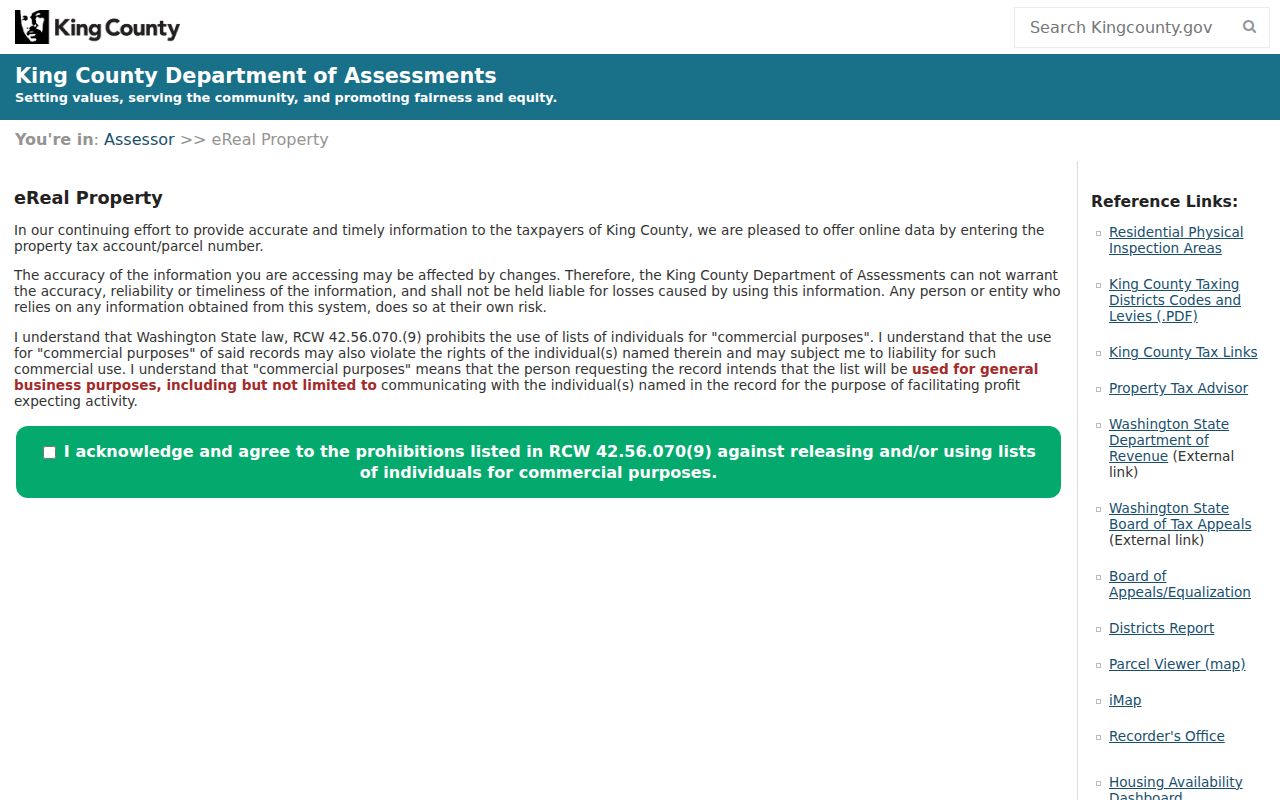
This view is useful for checking the current labels before relying on a saved set of instructions.
SeaTac Deeds Cross the Digital Line
Landmark is free to search, but its date breaks matter. Most recorded images from August 1, 1991 forward can be viewed online. The general index reaches to 1976, though entries from 1976 through the 1991 image cutover usually offer basic grantor, grantee, recording number, legal description, and date without an image. For 1852 through 1975, King County Archives holds Grantor-Grantee microfilm searched by name and date. Older work often needs a legal description because modern parcel indexing is inconsistent before roughly 2002.
The portal offers Name, Document Type, Book/Page, Consideration, Recording Number, Parcel ID, Record Date, Legal, Advanced Legal, and Quick Search paths. Name search expects last name, comma, first name. Date and document filters keep common names manageable. Search terms must be repeated when moving through results pages, and a hit should be opened to inspect its details and image. The image is unofficial; a certified copy comes from the Recorder.
The King County Landmark portal displays the index tabs used for the deed trail.
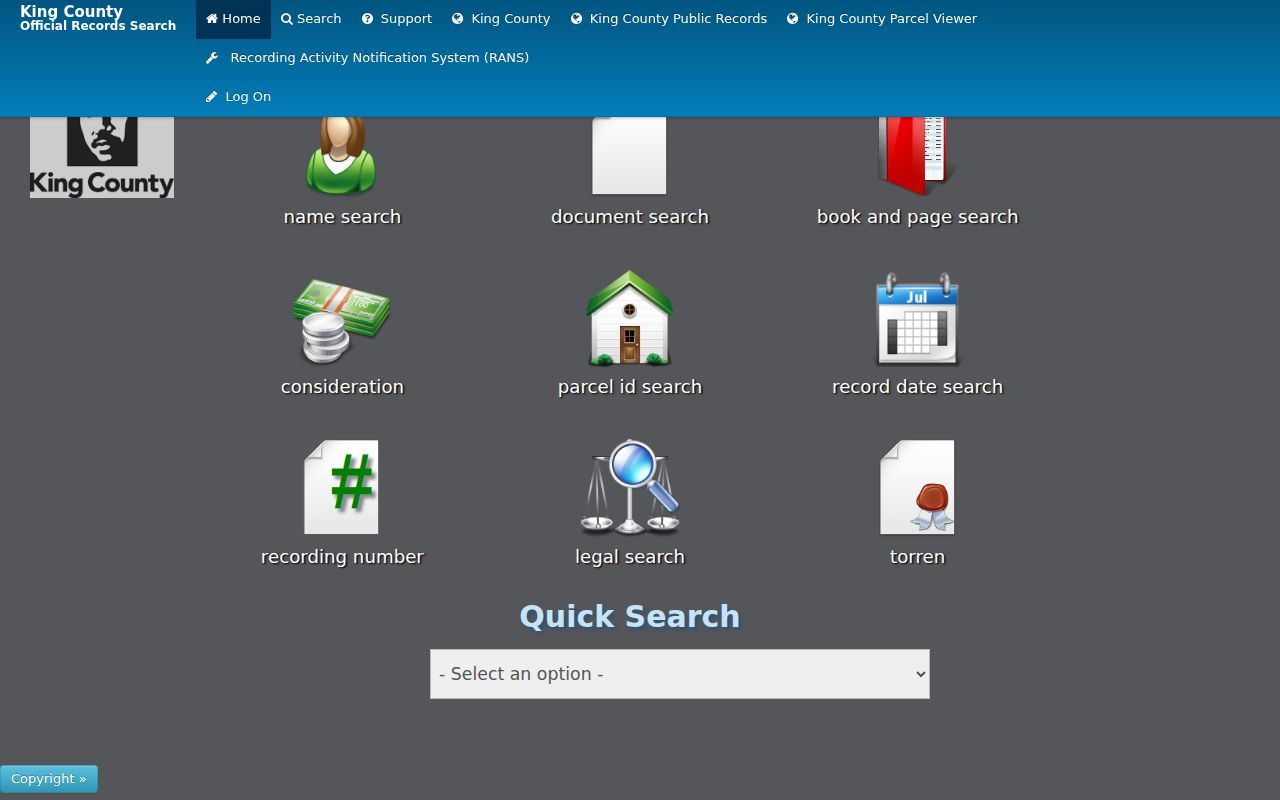
The many search tabs show why a missed parcel query should be followed by name, date, and legal-description searches.
Current SeaTac Residents Directory Sources
Current public rolls cover different slices of SeaTac. The property roll is broad for land but centers owners and taxpayers. Election data covers registered voters under state law. Recorded documents identify parties to instruments, not a household. City files add people whose names appear in public business. The residents directory is therefore a coverage map, not a promise that one source lists all residents.
| Source | Who It Lists | Keeper | Access |
|---|---|---|---|
| eReal property roll | Owner or taxpayer labels | King County Assessor | Free portal |
| Voter record | Registered voters | Washington SOS | VoteWA or regulated extract |
| Landmark index | Parties to deeds and other instruments | King County Recorder | Free index; copy rules apply |
| City proceedings | Speakers, petitioners, board members, and named contacts | SeaTac City Clerk | Posted files or PRA request |
| Court indexes | Parties to filed cases | Court of record | Index plus court request routes |
Compare sources by date and role. A matching name on an assessor card and voter record is stronger than either alone, but common names still require care. A court index does not provide a complete personal profile, and the Washington Courts statewide search warns that the court of record controls the official file. Keep a note of the custodian, result date, exact label, and any unresolved alternative.
SeaTac Voter Records Have Boundaries
Washington law makes specific voter fields public: name, address, political jurisdiction, gender, birth year, voting record, registration date, and registration number. It withholds the original registration form, full date of birth, driver's-license or Social Security information, and other confidential data. Statewide extracts go through the Secretary of State, are updated monthly, and are normally delivered within five business days. VoteWA is the current self-service registration route.
The public fields still have strict limits. RCW 29A.08.720 restricts use of voter lists for ads or solicitations involving property, products, services, or money. A mailing address and a residential address can differ. An inactive status does not prove a person left SeaTac. The Address Confidentiality Program can replace the actual residence, city, county, and precinct with protected handling. Never try to reverse an ACP address.
The VoteWA source is the official place to check the current registration interface.
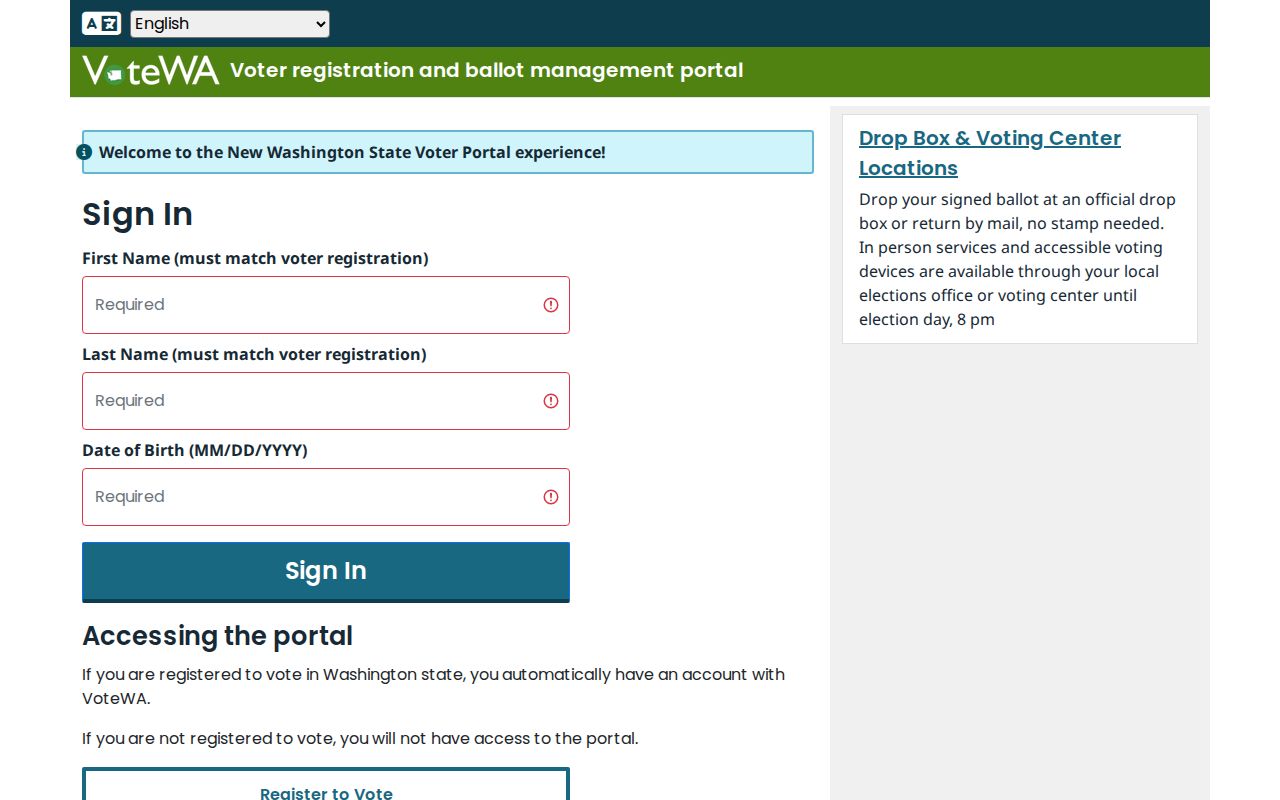
The live state route is preferable to an old copy because voter status and the interface can change.
Lawful use. Use SeaTac public records for a valid personal purpose. Do not expose protected addresses or use records to stalk, harass, intimidate, or harm anyone.
SeaTac City Records Add Context
The SeaTac City Clerk preserves council agendas, minutes, packets, ordinances, resolutions, notices, and citizen advisory records. Those files can place a person or group in a dated public event. They are not a general list of residents. Search posted records first. If the file is missing, use the city's public-records portal or contact Records Management with a clear record type, date range, address, and spelling variants.
Routing is part of the answer. Municipal court files go to SeaTac Municipal Court, not the general city request channel. Fire records from January 1, 2014 onward go to Puget Sound Regional Fire Authority, while earlier fire files route to the City Clerk. Collision reports go to Washington State Patrol. Permits appear through the LAMA system, whose visible options include Advanced Search, Inspections, and Open Data, though its exact dynamic field set was not confirmed in the research.
City packets are most useful when the known fact is a public role: a speaker, petitioner, board member, project contact, or organization representative. That appearance proves only the dated civic connection shown in the file.
SeaTac Court Names Need Verification
SeaTac cases can sit in municipal, King County District, King County Superior, or another Washington court. The statewide name and case search updates daily around 3 a.m., but it is a pointer rather than the official file. King County District Court eCourt can search by case number, last and first name, date of birth, company, and filing date. Result fields can include case number, title, type, filed date, status, and next or prior events. It does not make a court index a residence roll.
SeaTac Municipal Court asks for a defendant name with date of birth, a name with Washington driver license, or a case number; violation date and type can help. Some records remain private, and the current page lists a $20 CD charge. Superior Court controls its own case files, judgments, and probate records. Always confirm a match through the court of record, especially when two people share a name.
The King County Superior Court search entry shows the current access point.
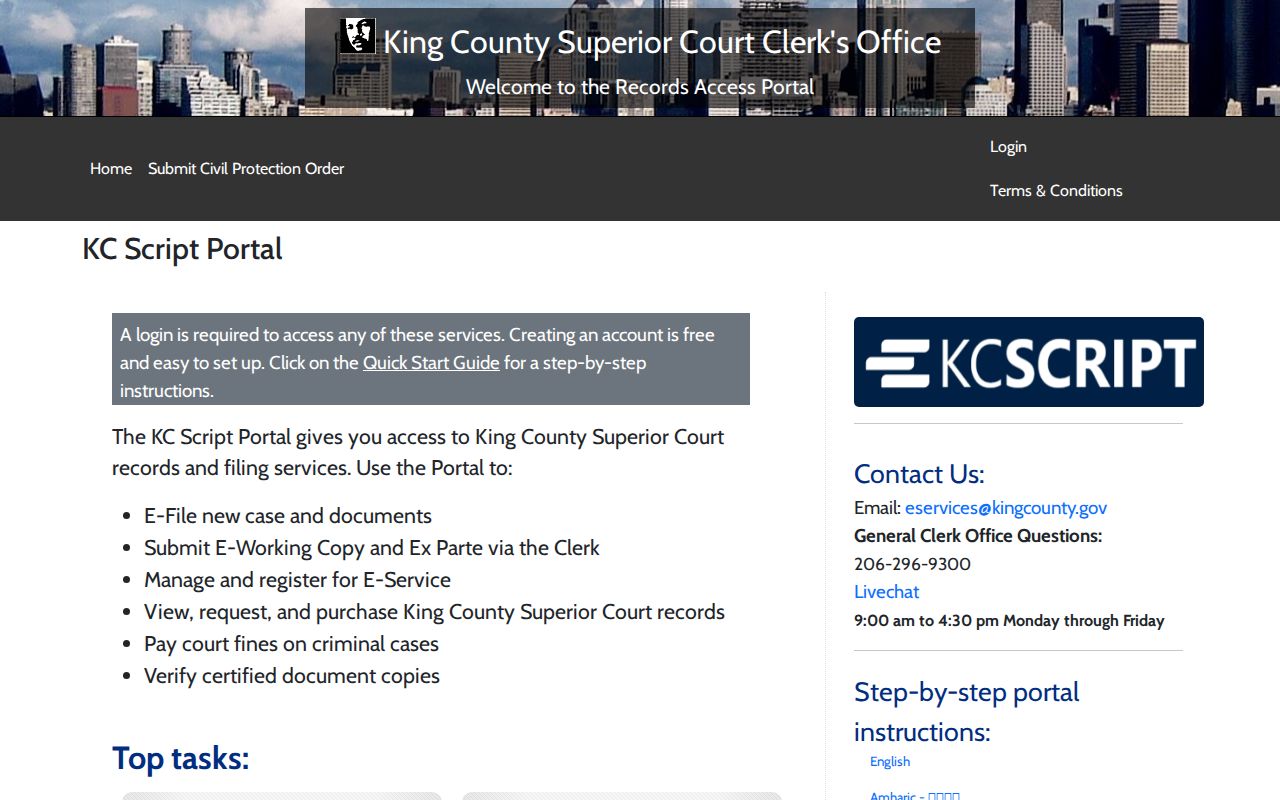
The image is an interface view, not proof of any SeaTac resident or case.
SeaTac Vital Records Use Set Rules
Washington Department of Health issues current certified birth, death, marriage, divorce, and fetal-death records. Certified birth and death copies require a qualified relationship or legal authority, identity proof, and the required application. Marriage and divorce certificates are generally available to anyone, but records received within the latest five months may still be held by the county auditor or Superior Court clerk. The historical release periods differ: birth and fetal-death records use a 100-year period, while death, marriage, and divorce records use 25 years under chapter 70.58A RCW.
The Washington State Digital Archives indexes King County marriages from 1855 onward, with image and index coverage that changes by series and date. A digital search hit supports research, but it is not a certified certificate. DOH accepts online, mail, and local-health ordering routes. No-record results generally do not refund the search fee, so first narrow names and dates with public indexes.
The DOH ordering page lays out the current request channels.
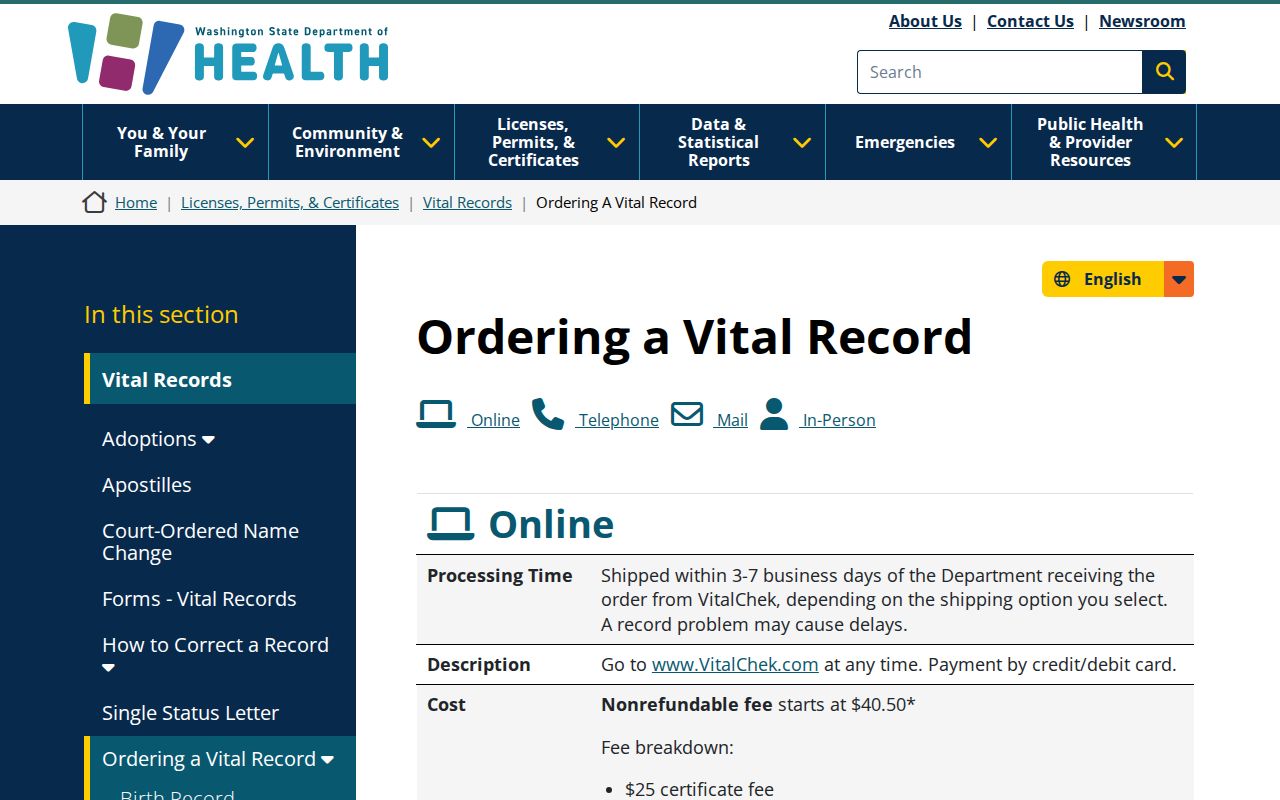
This state screen helps distinguish an index search from an official certificate request.
Official SeaTac Rolls Versus Profiles
Official records and commercial profile services answer different questions. A public custodian states why a roll exists, which fields are public, and how to request the source record. A commercial profile may merge old addresses, namesakes, phones, and licensed data without showing a clear chain back to a custodian. That can be fast, but speed does not make a match sound. For a SeaTac residents directory search, use the profile category only as an unverified lead and return to the public source.
| Point | Official roll or index | Commercial profile category |
|---|---|---|
| Purpose | Tax, recording, election, court, or city function | Combined person profile |
| Source date | Often shown by the custodian | May be unclear or mixed |
| Correction route | Named public office | Provider process varies |
| Best use | Verify one bounded fact | Generate a clue that still needs proof |
SeaTac Directory Terms in Plain Words
Record systems use short terms that can change the meaning of a match. Define them before copying a name into notes.
- Roll
- A list maintained for a set public purpose, such as tax assessment or voter registration.
- Index
- A finding aid that points to a record. It may not include the full document or image.
- Parcel
- A unit of land tracked by the assessor. It is not the same as a household.
- Situs address
- The physical site address of a parcel, which can differ from the tax mailing address.
- Criss-cross directory
- A directory arranged by street or telephone number rather than only by surname.
These distinctions keep the SeaTac residents directory from turning an owner into an occupant or an index line into a complete document.
Historical SeaTac Residents Directory Trails
The SeaTac name is new compared with the region's records. A 1989 mail vote led to formal incorporation in 1990, so earlier residents may be indexed under Highline, Angle Lake, Bow Lake, McMicken Heights, Riverton Heights, Sunnydale, Seattle, or a postal place. International Boulevard may appear as Highway 99. A sound residents directory search preserves each label instead of forcing old material into today's city name.
Seattle Public Library has digitized Seattle, Puget Sound, Washington State, and Pacific Coast directories from 1867 through 1940, with physical directories extending from 1890 through 1990. Valley View Library can help identify genealogy resources, microfilm, newspapers, and obituary routes. Highline Heritage Museum holds more than 300 oral histories and bound Highline Times volumes from the 1940s through the early 1990s. Its research route is by appointment. These collections can establish a dated address, spelling, occupation, organization, or family link, but each entry still needs comparison with deeds, marriages, probate, or parcel evidence.
King County Archives adds property and land-use collections from 1853 forward, including earlier recorded documents. Puget Sound Regional Archives property cards can include a legal description, building facts, assessed value, and photographs for a regional window around 1937 through 1972. The property and land-use guide shows the archive route.
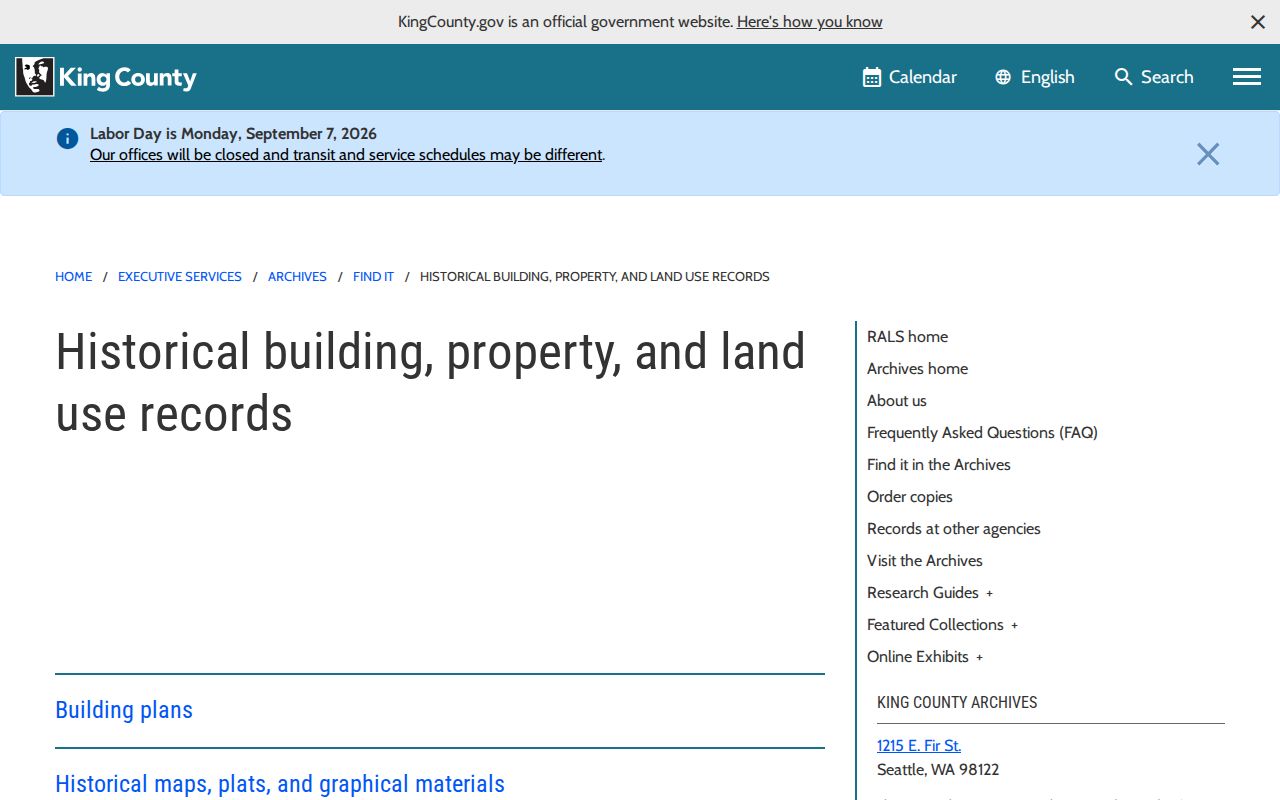
The archive view marks the handoff from a live parcel page to older cards, maps, and land files.
Use a narrow request when online text fails: surname, street, approximate year, predecessor community, and desired series. That approach helps library and museum staff search a real shelf without implying that any collection is a complete census of SeaTac.